Dr. Ramon Carrillo had a vision: he believed that Argentina needed 20,000
professional nurses to overcome the serious health problems which afflicted
its population. He set his priorities based on the areas where he felt
Argentina lagged behind the developed world: 1) Infant deaths; 2) Tuberculosis;
3) Venereal disease; 4) Mental Health; 5) Epidemics; 6) Helping People
with Disabilities; 7) Increasing Life Span. First, he wanted to cure the
sick, then prevent the illness, and finally attack the socioeconomic factors
which caused the illness (lack of proper nutrition, unsafe working conditions,
ignorance of basic hygiene). His plan, titled "Plan Analítico de Salud
Pública," published in 1947 by the Secretaria de Salud Pública de la Nación,
dealt with causes, consequences, and effects. Professional nurses were
indispensable to its success.
Dr. Carrillo found an intelligent and willing collaborator in Teresa Adelina
Fiora, secretary to the Nursing School in the Peralta Ramos Hospital,
who suggested that all existing nursing schools be centralized and their
course of study updated.
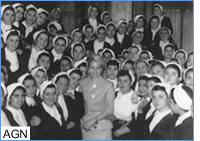 In
less than a year, Fiora, supported by a team of doctors which included
Jorge Albertelli, Evita's doctor, had organized the Eva Peron School of
Nursing. In
less than a year, Fiora, supported by a team of doctors which included
Jorge Albertelli, Evita's doctor, had organized the Eva Peron School of
Nursing.
The course lasted two years. During the first year the nurses studied
Hygiene and Epidemiology; Anatomy and Physiology; Semiology; General Pathology
and Therapeutics; national Defense and Public Disasters. Second year courses
included First Aid; Infirmary - medical and surgical; Obstetrics; Gynecology;
Pediatrics; Dietetics; and Social Medicine.
Post graduate studies took two more years to complete and included residence
training a the Hospital Presidente Peron in Avellaneda, and other new
Fundacion hospitals in Lanus, San Martin, and Ramos Mejia, where nurses
specialized in different areas including laboratory technology, neonatology
and psychiatry.
When the Society of Beneficence ran the nursing schools, nurses were little
more than glorified servants with no real medical training. Evita envisioned
professionals who could work in remote areas, without doctors if necessary.
Nurses were taught to drive the different vehicles of the Fundacion Eva
Peron: ambulances, hospital ambulances (each one with ten beds and an
operating theater); ambulances equipped for emergency surgery; jeeps;
motorcycles; and vehicles used for transporting doctors and nurses.
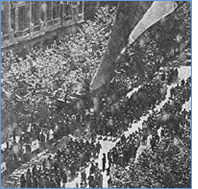 The
Nursing School, la Escuela de Enfermeras, was completely integrated into
the Fundacion by September of 1950 and by 1951 had graduated more that
5,000 nurses. The
Nursing School, la Escuela de Enfermeras, was completely integrated into
the Fundacion by September of 1950 and by 1951 had graduated more that
5,000 nurses.
The only limitation for entry into the Nursing School was that of age:
women had to be between the ages of 18 - 34. Students who could not afford
the fees were subsidized by the Fundacion Eva Peron. Adelina Fiora remembers,
"Many [of the candidates] came from very humble homes and had no concept
of the discipline necessary for the studies they would undertake. I thought
one way to teach them to be organized was to have them raise and lower
the flag in the patio of the school, just as is done in our primary and
secondary schools. That way they went into their classes together and
ready to work."
Delia Maldonado - one of the Fundacion nurses - also remembers the discipline
and the care that was to be taken of their sky blue uniforms. "Discipline
was something that was inculcated into us. A nurse must always be calm,
no matter what the problem or situation; otherwise, she cannot offer her
help in the way she should. This discipline also manifested itself in
the respect we showed the patient. The first lesson we learned was to
greet the patient. Greet him and ask him how he felt. We had to accompany
the patient because 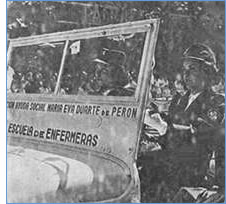 when
you check into a hospital, no matter how good the care or luxurious the
surroundings, you always feel a sensation of abandonment, We had to offer
confidence and assurance that all would be well. We never turned on the
lights of the ward [abruptly] or awakened patients by clapping our hands
or shouting [as was done when nurses were trained by the Society of Beneficence].
Also, we always had to wear our uniform and it was our responsibility
to keep it clean and neat. when
you check into a hospital, no matter how good the care or luxurious the
surroundings, you always feel a sensation of abandonment, We had to offer
confidence and assurance that all would be well. We never turned on the
lights of the ward [abruptly] or awakened patients by clapping our hands
or shouting [as was done when nurses were trained by the Society of Beneficence].
Also, we always had to wear our uniform and it was our responsibility
to keep it clean and neat.
Nurses did not just work in hospitals. Together with the Armed Forces,
they also participated in antimalarial and anti "mal de changas" campaigns.
They accompanied doctors and social workers all over the world to offer
solidarity and specialized treatment when disaster struck. Some even gave
their lives in services to humanity. In 1949, a terrible earthquake struck
Ecuador. Medical personnel from the Fundacion Eva Peron flew in a Fundacion
plane to the neighboring country to help. On its return to Buenos Aires
the plane crashed. Among those killed were two nurses, Amanda Allen and
Luisa Komel. Later the Ciudad lnfantil, the Children's City, would be
named in honor of Amanda Allen.
Bibliography: Ferioli, Nestor.
La Fundacion
Eva Peron/2. Buenos Aires:Centro Editor, 1990. |