When Evita was a little girl living in the small pampas town of Los Toldos, a very old man would sometimes come to the door of her house to ask for help. Evita called him "el señor Buen Día" because no matter how early or late he arrived, his greeting was always the same: "Good day, my little daughters!" Evita and her sister Erminda would run to ask their mother for a few coins to give him. After the death of their father, Doña Juana sewed far into the night to feed her children, but she always gave Evita something to help old "Mister Good Day."
In her biography, My Sister Evita, written twenty years after Evita's death, Erminda Duarte recalled those long ago days in the dusty pampas town and Mr. "Buen Día."
"He was one of those people who had suffered and been humiliated to the point where the only thing he had left was his humility. He seemed so forsaken! Yet his eyes had a luminous sweetness, as though he still had something in life to be grateful for.
"Nobody knew... where old Mr. Good Day lived, where he came from, who he was. Perhaps some thicket was his home, perhaps loneliness was his family. He was without doubt one of those people whom society expels from its midst, as though the person were no longer human.
"He was the first abandoned elderly person [Evita] came in contact with, and he awakened in [her] charity and a need to help."
On August 28, 1948, Eva Perón proclaimed the Decalogue of the Rights of Seniors, and on March 11, 1949, these rights (as well as the rights of workers), were incorporated into the revised 1949 Constitution. With the eyes of her heart, she must have seen old Mr. Buen Día as she announced that in the New Argentina, all seniors were endowed with ten rights:
1. The right to assistance and to protection
2. The right to housing
3. The right to food
4. The right to clothing
5. The right to health care
6. The right to spiritual care
7. The right to entertainment
8. The right to work
9. The right to tranquility, free from anguish and worry
10. The right to respect
On December 18, 1948, Evita made a speech affirming the rights of seniors:
"The drama of old age which lacks the most indispensable elements of life is a universal drama and bites with the same pain in all climates and under all latitudes. To solve the problem in one place is only to half solve it. No one has the right to ignore the voices of those who have worked all their lives and do not now have the possibility of spending their last days in tranquility but rather are condemned to a sorrowful, anguished, desperate old age; no society, no government has the right to ignore the morality of their cries."
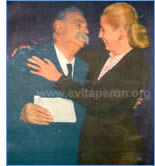 Social Security would not be available until 1950 when Congress, at the instigation of the Fundación Eva Perón, passed a law granting pensions to seniors. Evita did not want needy seniors to wait for help until the legislation passed. In 1948, she granted subsidies to those seniors whose needs had been verified by the social workers of the Fundación Eva Perón. Less than a year later, the Fundación began to give pensions to needy seniors over the age of sixty who did not qualify for social security. Many seniors came to Evita's office at the Ministerio de Trabajo y Previsión to apoly personally. On January 19, 1949, the newspaper Democracia told the story of a 113 year old Italian woman, born in Genova, who walked into the Ministry alone. When the surprised officials asked her why she hadn't taken a taxi, she replied, "And who would pay for it? A streetcar is fine, thank you very much!" Social Security would not be available until 1950 when Congress, at the instigation of the Fundación Eva Perón, passed a law granting pensions to seniors. Evita did not want needy seniors to wait for help until the legislation passed. In 1948, she granted subsidies to those seniors whose needs had been verified by the social workers of the Fundación Eva Perón. Less than a year later, the Fundación began to give pensions to needy seniors over the age of sixty who did not qualify for social security. Many seniors came to Evita's office at the Ministerio de Trabajo y Previsión to apoly personally. On January 19, 1949, the newspaper Democracia told the story of a 113 year old Italian woman, born in Genova, who walked into the Ministry alone. When the surprised officials asked her why she hadn't taken a taxi, she replied, "And who would pay for it? A streetcar is fine, thank you very much!"
In 1950, at the Colón Opera House, Evita awarded the first one thousand pensions to seniors, saying, "As President of the Fundación Eva Perón, I want to offer my homage to these senior citizens.... [T]his young woman reverently assures them that they can be confident that wherever Eva Perón is, there will also be a strong resolution to offer the descamisados her untiring service."
"In a United Nations special assembly, fifty-six nations expressed their admiration for the generosity and wisdom of the Decalogue and many of them adopted it as legislation in their own countries." (Celina Martinez Paiva and Maria Rosa Pizzuto de Rivero, La Verdad Vida y Obra de Eva Perón, Editoral Astral Buenos Aires, 1967, p.112)
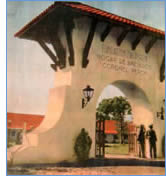 On October 17, 1948, Evita inaugurated a Senior Citizens' Home in Burzaco, Province of Buenos Aires. Three years ago to the day, the descamisados had filled the Plaza de Mayo, demanding that Colonel Perón be released from military custody. On that day, Evita had contracted a debt with the workers and the downtrodden who had obtained Perón's freedom; every new hospital, school, housing development her Fundación offered to the workers and the poor was, in her eyes, simply a partial payment of that debt. On October 17, 1948, Evita inaugurated a Senior Citizens' Home in Burzaco, Province of Buenos Aires. Three years ago to the day, the descamisados had filled the Plaza de Mayo, demanding that Colonel Perón be released from military custody. On that day, Evita had contracted a debt with the workers and the downtrodden who had obtained Perón's freedom; every new hospital, school, housing development her Fundación offered to the workers and the poor was, in her eyes, simply a partial payment of that debt.
The "Hogar Colonel Perón" covered almost eighty acres of rolling hills covered with over one hundred kinds of trees. The eucalyptus, oak, pine, cedar trees offered shade and protection. The stately ombú, native to Argentina, offered a place for the seniors to sip mate, a bitter herbal tea especially dear to gauchos who had worked the fields or herded cattle on the pampas.
The Home consisted of six pavilions in the California Mission style typical of the Fundación's architecture:
1. Offices, Social Services, Reception, Large Dining Room, Kitchen, Medical and Dental Consulting Rooms
2.&3. Residents' rooms, Bathrooms, Small "Family Rooms" where residents could meet to play chess or checkers, listen to music, etc.
4. Clothing, Linens, Washers, Dryers, Ironing, Sewing, Factory
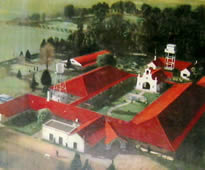 5. Large Meeting Room for socializing, cinema; Library, Artisans' Workshops (weaving, printing, making brooms, brushes, baskets) 5. Large Meeting Room for socializing, cinema; Library, Artisans' Workshops (weaving, printing, making brooms, brushes, baskets)
6. Sisters of Charity Residence
How did the Fundación incorporate the Senior Citizens' Rights into the lives of the 200 residents of the Colonel Perón Home?
1. The right to assistance: if the family could not or would not protect the senior citizen, then the State would do so, directly or indirectly; the Fundación Eva Perón offered the 200 residents every type of assistance needed.
2. The right to housing: residents slept in comfortable bedrooms, each with four beds, four night tables, four lamps, four chairs, four bedside rugs, closets, chintz curtains, shades, a chandelier. They had free run of the grounds of their home, with its flower gardens, pool, countryside.
3. The right to food: Four meals a day were served in the pleasant dining room: breakfast, lunch, tea and dinner. The tables settings were sturdy and of good quality. Fresh flowers adorned each table. Residents sat where and with whom they wished, and servers were attentive to all their requests. Special meals were served to those whose health required it. The menu was typically Argentine, with puchero (a stew of meat and vegetables), steak, pastas, fruit and pastry; much of the produce was grown on the farm.
4. The right to clothing: There were no uniforms in Evita's establisments. The seniors wore clothing of their choice, depending on to their activities at the moment: suits, blazers and ties; jeans or gaucho pants; pullovers, jackets or coats; leather shoes or alpargatas (espadrilles); pyjamas, bathrobes and slippers at night.
5. The right to health care: Social service workers worked on site; doctors and dentists gave regular check-ups in their consulting rooms. A small ten bed ward was available for short term care and the home's ambulance took serious cases to a hospital. Nurses were on call twenty-four hours and two caregivers were in each pavillion throughout the night.
6. The right to spiritual care: Social workers watched over the residents and provided counselling; priests and religious offered spriritual support; religious services were offered on Sundays and holy days. Nurses and employees were respectful, supportive and caring.
7. The right to entertainment: A van was available for excursions; the residents could listen to music, sing, play the piano, dance, exercise. Films were shown on a regular basis. The library contained over 1,500 volumnes. Small "family rooms" between the bedrooms were popular gathering places for games of chess, checkers or cards, especially in the evening. The fragrance of honeysuckle, roses, and flowers from the gardens, the soothing sound of water falling from the fountain, the shade of the trees, all drew the residents outdoors for walks and chats.
8. The right to work: about eighty percent of the residents worked. Everyone who worked received a salary which could be spent, saved, or invested. Residents chose their work, and they could teach their métier to others or learn a new job. A model farm, ecologically managed, contained horses, cows, goats, sheep, pigs, chickens, turkeys. The residents were the principal caregivers; they milked cows, herded flocks, fed poultry; they helped cultivate the land, planting and harvesting crops. Some residents worked in a printshop. Artisans made brooms, brushes, mops; weavers had their own workshop where they produced stockings and rugs; tailors worked at sewing or repairing clothes. Residents volunteered as librarians, musicians, or choir directors. A former engineer was in charge of the electricity for the home.
9. The right to tranquility: Residents were free to establish their own routine: work, walk, talk, enjoy the gardens and the surrounding countryside. All their needs were met: they received companionship, good food, clothing, entertainment. Nothing perturbed the peaceful environment.
10. The right to respect: all residents were called "Grandfather," a term of respect in Latin countries. When their caregivers addressed them affectionately as "Abuelo", they were made to feel part of a family. No one raised a voice to scold them. Evita came often to visit them, talk to them, pat them on the shoulder, encourage them. She must have wished that old Mr. "Buen Día" had been one of the residents.
By 1950, 2350 seniors lived in the Homes built by the Fundación Eva Perón. When the military overthrew Peron's constitutionally elected government in 1955, three Homes for Seniors under construction(in Santa Fé, Tucumán and Córdoba) were left unfinished. After seeing the use the military gave to the Home in Burzaco, Alfredo Palacios, a Socialist who had supported the military coup d'etat, commented, ... the first thing we are doing is taking away the roof that Eva Perón put over their heads... ."
Bibliography:
- Fundación Eva Perón: Un Sueño Hecho Realidad. Presidencia de la Nación, Secretaría de Prensa y Difusión. Buenos Aires. No date.
-
La Organización Social y los Derechos de la Ancianidad. Presidencia de la Nación, Secretaría de Informes. Buenos Aires, 1953.
-
"Los Derechos de la Ancianidad." Mucho Gusto June 1950:44. Ferioli, Néstor. La Fundación Eva Perón. Vol. 1. Buenos Aires: Centro Editor de América Latina, 1990.
-
Biblioteca del Museo Evita, Buenos Aires.
|



 ©
By Dolane Larson
©
By Dolane Larson