
   by
Dolane Larson by
Dolane Larson |
Hogar #1, at Carlos Calvo 102 , had space for 200 residents; Hogar #2, at Lafinur 2988 (now the headquarters of the Instituto Nacional de Investigaciones Históricas Eva Perón and the location of the Museo Evita) could house 280 residents and Hogar #3, at Austria 2561 could house 220. These Hogares had once been mansions but were delapidated and needed extensive renovation to be made habitable. Once renovated, they were luminous, comfortable and inviting (Ferioli, 103) with spacious patios for the children to play in, libraries, dining rooms with individual tables (so families could eat together) and many other amenities. Evita sent the gifts she had received in Europe: furniture, tapestries, fine paintings, rugs, porcelain and other objects d’art. The most spacious of the three Hogares was the one on Lafinur. Its small chapel was often used for baptisms and Evita’s own niece and nephew, the twins Blanca and Juan Alvarez Rodriguez, were baptised there. Evita was Blanca’s godmother and her sister Erminda was Juan’s.
The Hogares were open to anyone who needed assistance. However, mothers -unwed, separated, widowed, or abandoned- who had young children were moved to the top of the list and meeting their needs was the first priority. The most common problems the authorities had to solve were 1) unwed mother; 2) abandoned mother; 3) families where the parents were not married; 4) families with numerous children; 5) children with disabilities; 6) elderly people in need of assistance; 7) invalids; 8) people with chronic illnesses; 9) people needing medical treatment; 10) people in need of housing; 11) people who needed employment; 12) people who had to move and needed a place to stay; 13) immigrants. The Hogares provided all necessary services: finding employment, providing transportation, helping people who needed hospitalization, medicine or medical treatment; providing clothes and money; supplying orthopedic apparatus.
In 1954, 2280 people found shelter and help in the Hogares (Ferioli, 102). The two most numerous groups were unwed mothers and people who needed medical treatment.
Ferioli, Néstor. La Fundación Eva Perón / 1. Buenos Aires:Centro Editor de América Latina, 1990. Fraser, Nicholas & Marysa Navarro. Evita: The Real Life of Eva Perón. New York: W.W. Norton & Company, 1996. Ortiz, Alicia Dujovne. Eva Perón. New York: St. Martin’s Press, 1996. Fundación Eva Perón. Eva Perón and Her Social Work. Buenos Aires: Subsecretaria de Informaciones, 1950. Fundación Eva Perón. Hogares de Tránsito. Buenos Aires: Subsecretaría de Informaciones, no date. La Nación
Argentina: Justa, Libre, Soberana. Buenos Aires: Ediciones Peuser,
1950. |
 Except where otherwise noted, all contents copyright © 1998-2002, FIHEP. All rights reserved worldwide. |
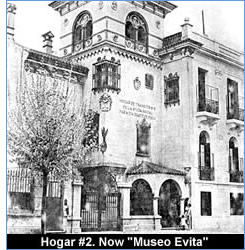 In 1948, the Fundación
opened three Hogares de Tránsito, temporary homes for people who
needed a place to live until their problems could be solved ( housing,
employment or medical attention). Preference was given to women with children.
In 1948, the Fundación
opened three Hogares de Tránsito, temporary homes for people who
needed a place to live until their problems could be solved ( housing,
employment or medical attention). Preference was given to women with children.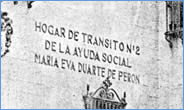 Residents
stayed for an average of about eight days or until the Fundación’s
social workers had solved their housing, employment, or medical problems.
When Evita inaugurated the Hogar #2 on Lafinur she promised that the Hogares
would provide “lodging with dignity, excellent food, spiritual,
material and moral support.” There would be classes for adults (sewing,
typing) and recreation for children (movies, crafts); “everything
they need” was to be given freely and for free.
Residents
stayed for an average of about eight days or until the Fundación’s
social workers had solved their housing, employment, or medical problems.
When Evita inaugurated the Hogar #2 on Lafinur she promised that the Hogares
would provide “lodging with dignity, excellent food, spiritual,
material and moral support.” There would be classes for adults (sewing,
typing) and recreation for children (movies, crafts); “everything
they need” was to be given freely and for free. 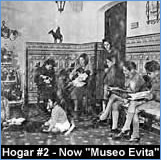
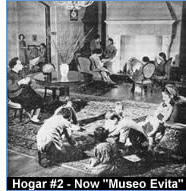 Each
person who stayed in the Hogares was able to choose his or her own clothes
and shoes from the “Clothing Section”. Children played in
luminous patios filled with playground equipmentand watched over by licensed
caregivers. Each Hogar had a modern, well-equiped clinic staffed by a
woman doctor and assistents. Classes were offered so that the women might
leave better equipped to earn a decent salary as a secretary or a seamstress
(or at least be able to sew for her family) and not have to be a maid
by default.
Each
person who stayed in the Hogares was able to choose his or her own clothes
and shoes from the “Clothing Section”. Children played in
luminous patios filled with playground equipmentand watched over by licensed
caregivers. Each Hogar had a modern, well-equiped clinic staffed by a
woman doctor and assistents. Classes were offered so that the women might
leave better equipped to earn a decent salary as a secretary or a seamstress
(or at least be able to sew for her family) and not have to be a maid
by default.